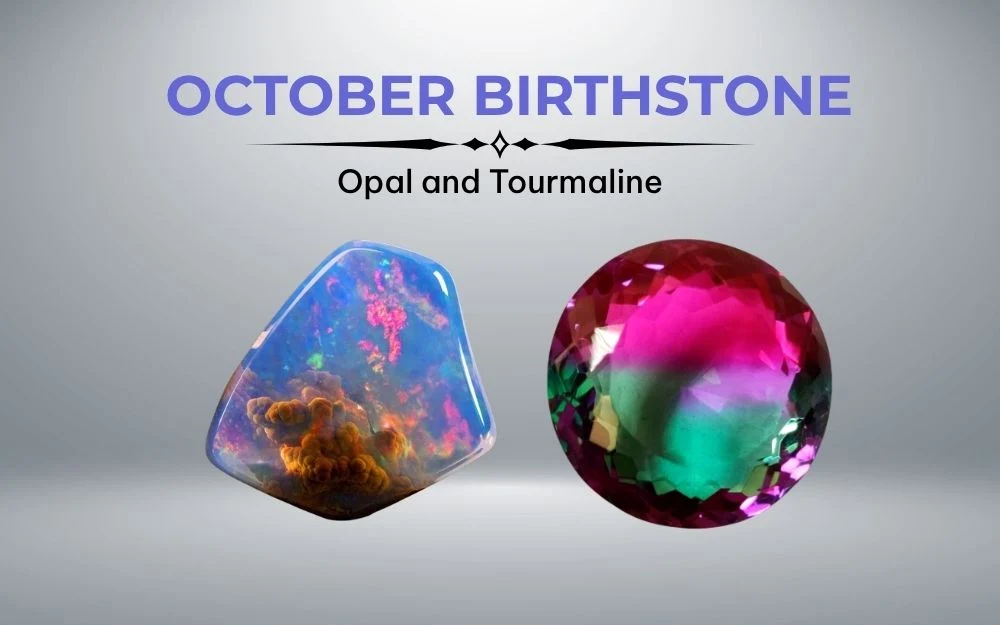
If you were born in October, you get two birthstones instead of one. The October birthstone is opal, with tourmaline as the modern alternative. They look nothing alike, they behave differently on the hand, and they suit different budgets and lifestyles.
Most guides stop at “opal is for hope, tourmaline is for creativity.” That’s pleasant, but it won’t help you buy a ring. This guide covers what each stone is, how they differ in daily wear, and how to pick one that will still look good in twenty years.
Why October Has Two Birthstones
Opal is the traditional October Birthstone. It appeared on the standardized birthstone list published by American jewelers in 1912. Tourmaline was added in 1952 by the Jewelry Industry Council of America, now Jewelers of America, alongside alternates for several other months.
The reason is partly practical. Opal is lovely but delicate, and tourmaline gave October babies a tougher option in a huge range of colors. Neither is “more official.” Both are accepted today, so you can choose whichever suits you.
Opal: The Traditional October Birthstone
Opal is unusual among gemstones because its color comes from structure rather than chemistry. It is made of tiny silica spheres stacked in a pattern that bends and splits light, producing flashes of color that shift as you move the stone. Jewelers call this play-of-color.
Main types of opal
- White and light opal: a pale body color with soft flashes. Often the most affordable fine opal.
- Black opal: a dark body color that makes the flashes look brighter. It is rare and typically the most valuable.
- Boulder opal: thin seams of opal still attached to ironstone, giving each piece a rugged, earthy pattern.
- Fire opal: transparent to translucent in warm orange and red. It often has no play-of-color, but the body color is the appeal.
- Ethiopian (Welo) opal: bright and vivid, but it can be more sensitive to moisture changes, so ask the seller about its stability.
Australia is the world’s dominant source of opal. Ethiopia, Mexico, and the United States also produce it.
The durability catch
Opal ranks around 5.5 to 6.5 on the Mohs scale, so it scratches more easily than many popular gems. It also contains water, which means it can crack with sudden temperature swings or very dry conditions. A ring worn every day for years will show wear. Earrings, pendants, and brooches are gentler settings.
Tourmaline: The Modern October Birthstone
Tourmaline is a family of minerals rather than a single gem, which explains its range of colors. You can find it in pink, green, blue, yellow, black, and even two or three colors in the same crystal.
Colors and varieties worth knowing
- Pink tourmaline: the classic October pairing. Colors run from pale blush to hot pink.
- Rubellite: a deep red to purplish-red variety, usually priced above ordinary pink.
- Green tourmaline: often called verdelite, available in shades from mint to forest green.
- Paraíba tourmaline: a vivid, almost neon blue-green first found in Brazil in the 1980s. It is colored by copper, and fine stones are very expensive.
- Watermelon tourmaline: pink centers with green rims, usually sold as slices.
- Indicolite: blue tourmaline, rarer than pink or green.
With a hardness of about 7 to 7.5, tourmaline holds up much better than opal for everyday wear, though a hard knock can still chip it.
Opal vs. Tourmaline: Which Should You Choose?
| Factor | Opal | Tourmaline |
|---|---|---|
| Look | Shifting flashes of color | Solid, saturated color |
| Hardness (Mohs) | About 5.5–6.5 | About 7–7.5 |
| Everyday ring wear | Risky | Generally fine |
| Care | Needs gentle handling | Easy |
| Price range | Wide, from modest to very high | Wide, from modest to very high |
A few honest notes on this comparison:
Choose opal if you love a stone that looks different in every light and you’re happy to treat it with care. It’s a good fit for earrings, pendants, and occasional-wear rings.
Choose tourmaline if you want a ring you can wear daily, or you prefer rich, clear color. It’s the safer pick for engagement rings and stacking bands.
Budget realities: Neither stone has a fixed price. A small pink tourmaline can be quite affordable, while a large Paraíba can cost far more than many diamonds. Quality opal varies just as dramatically, and strong play-of-color in a larger stone raises the price quickly. Compare stones in person or ask for video in natural light.
Common Misconceptions About Opal
Opal’s reputation for bad luck is widely repeated and mostly traced to a 19th-century novel. Many writers point to Sir Walter Scott’s Anne of Geierstein, in which an opal seems to bring misfortune to its wearer. Opal had been prized for centuries before that. Today the superstition survives mostly as a conversation piece.
The real concern is practical. Opal needs gentler treatment than most gems, and some people confuse that fragility with a curse.
Another misunderstanding is that every opal “dries out” on its own. Properly mined and finished opal is usually stable, but extreme heat, sudden temperature changes, and long exposure to very dry air can cause cracking. Storing it with some common sense is enough for most owners.
Common Mistakes When Buying an October Birthstone
- Buying opal for a daily-wear ring without a protective setting. A bezel setting offers far more protection than a high prong.
- Ignoring synthetic and imitation options. Lab-created opal and doublets or triplets (a thin slice of opal glued to a backing) are legitimate products, but they should be labeled and priced accordingly.
- Judging color from a photo. Opal’s flash and tourmaline’s saturation both change with lighting. Ask for video or view the stone in person.
- Assuming all tourmaline is the same. Quality, origin, and color rarity affect price enormously.
- Skipping the certificate for expensive stones. For high-value purchases, a report from a recognized gemological laboratory is worth requesting.
How to Care for Your October Birthstone
Opal care:
- Clean with a soft cloth and lukewarm water. Avoid ultrasonic and steam cleaners.
- Take it off before swimming, cleaning, or heavy activity.
- Store it separately in a soft pouch so harder stones don’t scratch it.
- Avoid leaving it in a hot car or direct sun for long periods.
Tourmaline care:
- Warm soapy water and a soft brush usually work well.
- Ultrasonic cleaners are fine for many stones, but check first if yours has fractures or has been treated.
- Keep it away from sharp impacts.
Meaning and Symbolism
Opal has long been associated with hope, creativity, and change, probably because its colors shift so dramatically. Tourmaline is often linked with creativity and balance, and pink tourmaline with affection. These associations come from tradition and folklore rather than science, so treat them as meaningful stories rather than facts about the stone.
Opal is also the traditional gem for a 14th wedding anniversary in some lists, which makes it a thoughtful gift beyond birthdays.
Frequently Asked Questions
What is the October birthstone?
Opal is the traditional October birthstone, and tourmaline is the modern alternative. Both are officially recognized.
What color is the October birthstone?
Opal can show nearly every color, depending on type. Tourmaline is commonly pink for October, though it comes in many other shades.
Is opal or tourmaline more valuable?
It depends on the specific stone. Fine black opal and Paraíba tourmaline can be extremely valuable, while lower-grade examples of either are far more affordable.
Can I wear an opal ring every day?
You can, but expect some wear over time. A protective setting and removing the ring during rough tasks will help it last.
Which zodiac signs share October birthstones?
October covers Libra and Scorpio. Both stones are commonly associated with these signs, though zodiac-based birthstone lists vary by tradition.
How can I tell if an opal is real?
Natural opal has irregular, shifting patches of color, while many imitations look too uniform. Doublets and triplets show a join line from the side. For anything expensive, get a lab report.
Does tourmaline need special care?
Not much. It’s tough enough for regular wear but still deserves protection from hard knocks.
Is the October birthstone a good gift?
Yes, particularly if you match the stone to how the recipient lives. A hands-on worker will get more joy from a tourmaline ring than from an opal one.
Final Thoughts
The October birthstone gives you a real choice: opal for its shifting, almost living color, or tourmaline for dependable beauty and a rainbow of options. If you’re buying a ring for daily wear, lean toward tourmaline. If you want drama and don’t mind gentle care, opal is hard to beat.
Whichever you pick, look at the stone in natural light, ask about treatments and origin, and buy from a seller who answers questions plainly.